

Last Updated: October 25, 2026
Quick Summary
Local seo for HVAC companies means winning the Map Pack by strengthening the signals you control: proximity, relevance, and prominence. Prioritize a fully completed Google Business Profile, consistent NAP citations, a steady review request system, and one genuinely useful service-area page per city you actually serve.
- Fix your Google Business Profile first: it is the highest-use asset you own and it is free.
- Set HVAC contractor as your primary category and list only cities you actually drive to.
- Ask for reviews right after the AC comes back on, and respond within 48 hours.
- Build service-area pages in order of revenue, starting with your top two or three towns.
- Keep your real business number on your profile and use tracking numbers only on the website.
Table of Contents
- Why Local SEO Decides Which HVAC Company Gets the Call
- Google Business Profile for HVAC Companies: The Map Pack Engine
- HVAC Service Area Pages That Rank for Near Me Searches
- An HVAC Customer Reviews Strategy That Builds Local Rankings
- Citations, NAP Consistency, and Local Link Building
- Your HVAC Local SEO Checklist, Prioritized by Impact
- Track Calls, Booked Jobs, and Revenue From Local Search
- Book a Free Strategy Call With MSJ Marketing Consultants
- Frequently Asked Questions
Why Local SEO Decides Which HVAC Company Gets the Call
When a furnace dies at 11 p.m., nobody compares ten companies. They type “AC repair near me,” scan the map, and call one of the top three names. That split-second decision is what local seo strategies for hvac companies are really fighting over. At MSJ Marketing Consultants, we’ve watched family-run shops lose jobs purely because a bigger outfit ranked first in the Map Pack.
Most HVAC owners treat marketing as a website project. It isn’t. It’s a visibility contest inside a small geographic box, decided by signals most contractors never touch.
- Proximity to the searcher
- Relevance to the query
- Prominence across the web
Google’s own guidance on how local ranking works confirms these three factors. You can’t move your shop closer to a customer. You can absolutely improve the other two.
Below is the exact playbook we use, from your Google Business Profile to the tracking that proves which calls came from search.
Google Business Profile for HVAC Companies: The Map Pack Engine
Your Google Business Profile is the single highest-use asset you own. It’s free, sits above the organic results, and drives most local calls for service businesses. If you fix one thing this quarter, fix this.
Categories, Service Areas, and the Details That Trigger Calls
Pick your primary category carefully: “HVAC contractor” should be primary, with secondary categories like “Air conditioning repair service” and “Furnace repair service” where they genuinely apply.
Fill in the rest:
- Hours, including emergency availability if you offer it
- Phone number as a local line, not a toll-free number
- Services with real descriptions, not keyword soup
For a deeper walkthrough, see our guide on how to improve Google Business Profile rankings in 2026.
Posts, Photos, and Q&A: Keeping the Profile Active
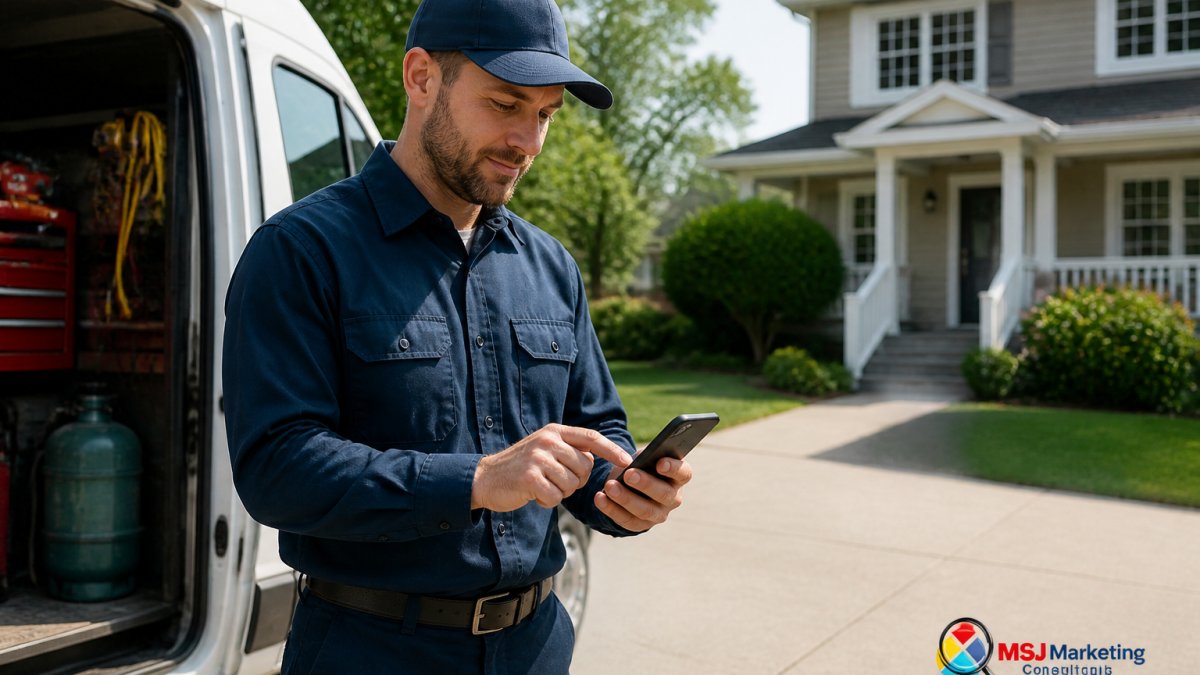
An abandoned profile signals an abandoned business. Post weekly, even if it’s just a seasonal reminder, and upload real job-site photos, a technician on a ladder, a new condenser unit on a pad, instead of stock images. The Q&A section is free real estate: seed it with the questions customers actually ask, then answer them fully.
HVAC Service Area Pages That Rank for Near Me Searches
One page for your whole metro won’t cut it. HVAC service area pages are dedicated pages for each city or neighborhood you serve, and they’re how you show up for “AC repair in [suburb]” searches. The difference between a page that ranks and one that gets filtered is architecture, not word count.
Decide What Counts as a Real Service Area
Before you write a page, draw the boundary. A service area is a place you actually dispatch trucks to on a normal day, not every zip code inside a 50-mile radius. A common pattern among shops that rank well:
- Core areas (roughly the cities you reach in under 30 minutes): full dedicated page each
- Secondary areas (30-60 minutes out): one page per town, or a grouped page for a cluster of small towns
- Edge areas (over an hour, or only served on a premium basis): mention on the main service page, don’t build a page
Building a page for a town you won’t drive to creates a bad user experience, a thin-content signal, and the doorway-page problem described below.
The Doorway-Page Line, and How to Stay on the Right Side
Google’s guidance on doorway pages targets pages that exist only to funnel searchers to the same destination with near-identical content. The test isn’t whether the page mentions a city, it’s whether the page would still be useful if you deleted the city name.
A practical self-check for each location page:
- Unique service detail. Does the page mention something true only of that area, housing stock (older bungalows with window units, new-build subdivisions with heat pumps), typical utility setup, common local code or permit quirks, or a specific neighborhood?
- Unique proof. Are there reviews, job photos, or a technician quote tied to that area?
- Unique logistics. Does it state realistic response times, dispatch windows, or after-hours coverage for that area?
- Unique FAQ. Does it answer a question a homeowner there would actually ask?
If you can’t fill at least three of those four with real material, don’t publish the page. A grouped page for a cluster of small towns beats five thin pages.
What Belongs on Each Location Page
A strong location page includes:
- The city name in the title, H1, and first paragraph, used naturally, not stuffed
- Local landmarks, neighborhoods, and driving context
- A phone number and clear call button above the fold
Multi-Location Shops: Locations vs. Service Areas
If you run more than one physical shop, keep two page types separate:
- Location pages, one per real, staffed address with its own phone number and hours. These map to a Google Business Profile for each location.
- Service-area pages, the towns each location covers. These do not get their own business profile.
Don’t create a profile for a P.O. box, a virtual office, or an address where no one actually works, that violates eligibility rules and risks suspension. If two shops overlap, assign each town to one location page so you don’t compete with yourself.
Schema and Internal Linking
Adding schema markup for local businesses helps these pages qualify for richer search results. Use LocalBusiness (or the HVACBusiness subtype) with the address, phone, area served, and hours, kept consistent with your business profile. Then link every service-area page from a single hub page, and link each one to the two or three service pages most relevant to that area.
Build service-area pages in order of revenue, not alphabetically. Start with the two or three towns that produce the most booked jobs, get them genuinely strong, then expand. A handful of deep pages outperforms a wall of thin ones.
An HVAC Customer Reviews Strategy That Builds Local Rankings
Reviews are the closest thing local search has to a cheat code. They influence rankings and the click.
Build a simple system:
- Ask at the moment of relief, right after the AC comes back on
- Send a text with a direct review link
- Train techs to mention it in person
- Respond to every review, good or bad, within 48 hours
Never buy reviews. Never gate them to only happy customers. Both violate FTC rules on fake reviews and testimonials, and both get profiles suspended.
If you want the full mechanics of how review signals feed rankings, read our breakdown of customer reviews SEO rankings.
Citations, NAP Consistency, and Local Link Building
A citation is any mention of your business name, address, and phone number online. NAP consistency means those three details match exactly everywhere.
Inconsistency is silent and corrosive. One directory lists “Suite 4,” another “Ste 4,” and Google gets less confident about which is real. Audit the big ones first:
| Source | Priority | Why It Matters |
|---|---|---|
| Google Business Profile | Critical | Drives Map Pack |
| Apple Business Connect | High | Powers Apple Maps |
| Bing Places | High | Feeds Bing and Copilot |
| Yelp | Medium | High consumer trust |
| Angi / HomeAdvisor | Medium | HVAC-specific demand |
| Trade associations | Medium | Industry authority |
Then earn local links. Sponsor a youth sports team, join the chamber of commerce, get quoted in the local paper. One link from a local news site beats fifty from random directories.
Our guide to local citation building and business listings covers the full cleanup process.
Your HVAC Local SEO Checklist, Prioritized by Impact
Not all tasks are equal. Here’s the order we’d tackle them in, based on what moves rankings fastest.
| Priority | Task | Effort | Impact |
|---|---|---|---|
| 1 | Claim and fully complete Google Business Profile | Low | High |
| 2 | Fix NAP consistency across top directories | Low | High |
| 3 | Launch a review request system | Medium | High |
| 4 | Build one service area page per city | High | High |
| 5 | Add local schema markup | Low | Medium |
| 6 | Post weekly to your profile | Low | Medium |
| 7 | Earn local links and sponsorships | High | Medium |
Start at the top. Don’t skip to link building because it feels more advanced. The basics carry more weight than most contractors realize.
Track Calls, Booked Jobs, and Revenue From Local Search
Rankings are a means, not an end. The number that matters is booked jobs. Most HVAC reporting stops at calls and rankings; the shops that win treat local search as a revenue channel with its own funnel. Here’s how to build and read it month by month.
Set Up Call Tracking Without Breaking NAP
Call tracking is where most shops accidentally damage their local SEO. The fix is a dynamic number insertion (DNI) setup:
- Keep your real business number as the primary number on your Google Business Profile, citations, and schema. Never swap it for a tracking number.
- Use a tracking number that swaps in only on the website for visitors arriving from search, so you can attribute web calls without changing what directories see.
- Use a separate tracking number per channel (website search traffic, service-area pages, profile calls) so you can tell which asset produced the call.
A common pattern: one tracking number for the profile, one for the website, then break the website number down by landing page. That’s enough granularity to make decisions without a tangle of numbers.
Build the Funnel: Call → Qualified Lead → Booked Job
A raw call count flatters everyone. Track each stage:
| Stage | What to record | Why it matters |
|---|---|---|
| Call | Source, landing page, time, duration | Shows which asset drives contact |
| Qualified lead | Service type, service area, whether the caller is a real prospect | Filters out wrong-number and price-shopper calls |
| Booked job | Appointment set, date, job type | Connects marketing to dispatch |
| Completed job | Ticket, job type, whether it was a repair, maintenance, or install | Connects marketing to revenue |
Then compute two ratios that matter more than call volume:
- Booking rate = booked jobs ÷ qualified leads
- Revenue per lead = completed-job revenue ÷ qualified leads
A page that produces fewer calls but a higher booking rate and higher revenue per lead is the better page. Most agencies never show this number because it requires tying marketing data to dispatch and invoicing.
Attribute Revenue, Not Just Traffic
To attribute revenue, join three data sources: the call tracking platform, your dispatch or field-service software, and your invoicing. Match the call to the booked job by phone number or customer record, then roll up by source and landing page each month.
If you can’t join all three yet, start with a simple monthly report:
- Calls from search, by landing page
- Qualified leads from those calls
- Booked appointments from those leads
Ask your agency for these numbers. If they can’t produce them, they’re guessing.
Plan Around Seasonal Demand
HVAC search demand is not flat, and neither should your local SEO calendar be. A practical month-by-month rhythm:
- Late winter / early spring: push AC tune-up content and profile posts; start review requests ahead of the cooling rush so you enter summer with fresh reviews.
- Late spring / early summer: peak AC repair and replacement demand; keep service-area pages current, respond to reviews fast, and keep emergency availability accurate on the profile.
- Late summer / early fall: furnace tune-up and heating content; refresh heating service-area pages and FAQ answers.
Plan content, profile posts, and review requests around those curves rather than posting the same message year-round. The shops that rank in July usually started their summer push in April.
Local SEO reporting that stops at rankings and calls hides the only number that matters: revenue per lead. Join call tracking, dispatch, and invoicing, then read the funnel month by month against the seasonal demand curve.
Book a Free Strategy Call With MSJ Marketing Consultants
Local search rewards the shop that shows up consistently, not the one with the biggest budget. The gap between page one and page three is measured in missed calls and lost installs.
At MSJ Marketing Consultants, we work with family-run HVAC and plumbing companies to close that gap.
If you’re ready to see where your visibility stands and what it would take to fix it, get a straight answer on your next step. You can hire a local SEO agency in Texas and book your free strategy call.
Frequently Asked Questions
How can an HVAC company improve its local SEO?
Start with the assets that move local rankings fastest: claim and fully complete your Google Business Profile, keep your name, address, and phone number identical across every directory, and publish a service area page for each city or neighborhood you cover. Then build an HVAC customer reviews strategy that asks every satisfied customer for a review at job completion. Add local keywords with geographic modifiers to page titles and headings, and track calls and booked jobs so you know which efforts pay off. Most companies see movement in the Map Pack before broader organic gains.
What should an HVAC company include in its Google Business Profile?
Use the most specific primary category available, list every service you offer, and define your service area by the cities and ZIP codes you actually cover. Add hours, emergency availability, license information, and financing options where they apply. Upload real photos of your technicians, vans, and completed installs rather than stock images. Answer the pre-populated Q&A section yourself, and post seasonal updates such as tune-up reminders before summer and heating checks before winter. A complete profile gives Google more signals to match you to near me searches.
How do HVAC companies get more customer reviews?
Ask at the moment of satisfaction, which for HVAC is right after the technician finishes and the system is running. Send a text message with a direct review link before the technician leaves the driveway. Train technicians to mention the review request in person. Respond to every review, positive or negative, within a few days. Keep the flow steady rather than chasing a burst of reviews in one week, since consistent volume reads as more credible. Never offer incentives for reviews, as that violates Google’s review policies.
How much should I pay for local SEO?
Pricing depends on the scope of services required. Ask any provider to break the quote into specific deliverables so you can compare like for like. MSJ Marketing Consultants publishes pricing on its website and offers a free strategy call, so you can see the scope and cost before committing to a retainer.
