

Table of Contents
- Why Local SEO Matters for Dental Practices: The New-Patient Math
- How Local Search Works for Dentists
- Google Business Profile for Dentists: The Highest-Use Asset
- Dental Practice Online Reviews: Reputation as a Ranking Signal
- Dentist Local Keyword Research: Finding the Searches That Book Patients
- On-Page SEO, Citations, and NAP Consistency for Dental Websites
- A Measurable Local SEO Plan: Timelines, KPIs, and Attribution to Booked Patients
- Frequently Asked Questions
Last Updated: October 19, 2026
Why Local SEO Matters for Dental Practices: The New-Patient Math
Most dental practices lose new patients before the phone ever rings. Someone nearby searches “dentist near me,” scans a handful of map results, and books with a name they recognize.
The stakes are simple. A practice that ranks in the local pack gets calls. One that doesn’t gets scrolled past. Below, we’ll show you exactly how local search works for dentists and how to build a plan.
How Local Search Works for Dentists
Local search runs on proximity, relevance, and prominence. Google weighs where the searcher is, how well your listing matches the query, and how established your practice looks online.
For a dental practice, that means three things matter most:
- A complete, accurate Google Business Profile
- Consistent practice details across the web
- A steady flow of recent, honest reviews
Get those right and the map results start working for you.
The Local Pack and Google Maps
The local pack is the block of three map results that appears above regular search listings. It’s prime real estate for a dental practice.
Google pulls those results from Google’s guidance on local ranking. The signals are proximity, relevance, and prominence. You can’t move your office closer to a patient. You can control relevance and prominence.
Near Me Searches and Service-Area Keywords
“Near me” searches are how most patients look for a dentist. They’re also the hardest to game, because Google leans on location.
The workaround is service-area keywords. Instead of chasing a broad term, target the specific searches patients in your area type:
- “emergency dentist [neighborhood]”
- “pediatric dentist near me”
- “braces [city]”
- “family dental office open Saturday”
These phrases bring in people who are ready to book. A generic term brings in everyone.
Google Business Profile for Dentists: The Highest-Use Asset
If you do one thing, make it your Google Business Profile. It’s the free listing that powers your map visibility, and it’s where most new patients first see you.
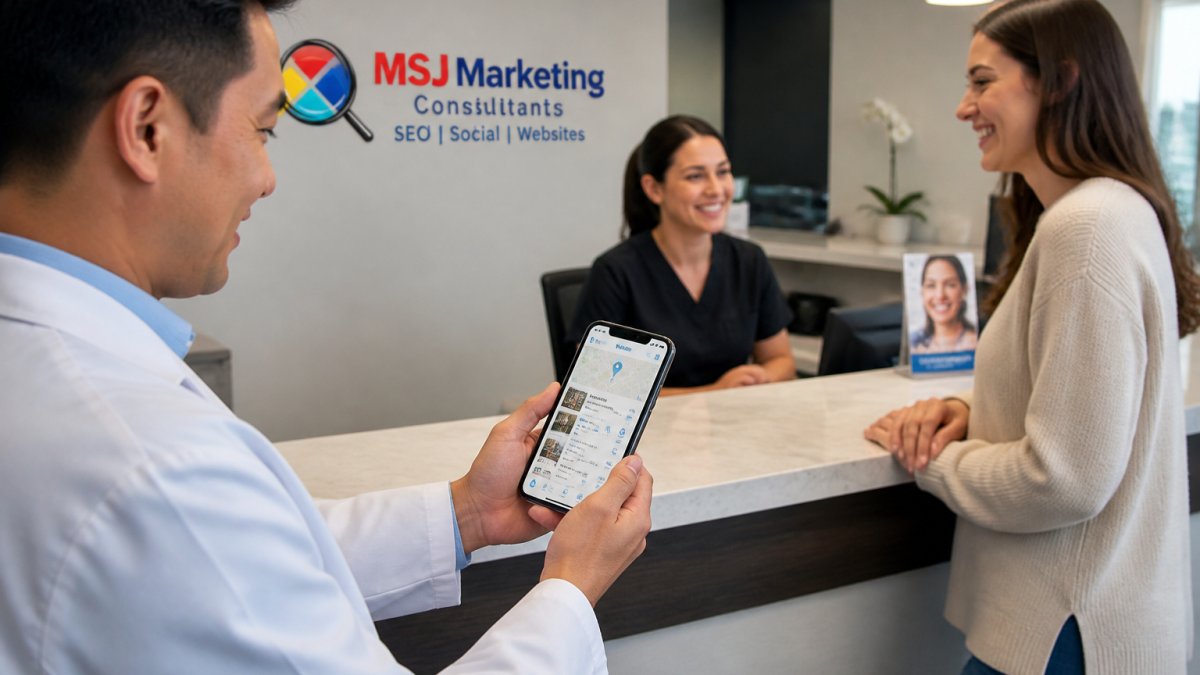
Build it out completely:
- Pick the most specific category (e.g., “Dentist” or “Pediatric Dentist”)
- Add every service you offer, from cleanings to braces
- Post office photos, team photos, and exterior shots
- Set accurate hours, including weekend and holiday notes
Most practices set their hours once and forget them. Update them for holidays and staffing changes. A patient who shows up to a locked door leaves a one-star review, and that review outlasts the holiday.
Dental Practice Online Reviews: Reputation as a Ranking Signal
Reviews do double duty. They shape your ranking, and they decide whether a patient calls you or the practice next door. For a dental practice, they also carry a compliance dimension most generic SEO advice ignores: reviews can contain protected health information, and your responses can create liability if handled carelessly.
Why Recency Beats Volume
A common mistake is chasing volume and ignoring recency. Google favors a steady stream of recent reviews over a big pile of old ones. Ask every satisfied patient, every week, through a post-appointment follow-up that links directly to your profile. A practice that collects a handful of reviews every month will outrank one that collected fifty reviews three years ago.
The Compliance Layer: Consent and Confidentiality
Dental reviews are different from restaurant reviews because the reviewer may be a patient, and the practice’s response can confirm a treatment relationship. Consider these operating rules:
- Get consent before you ask. Ask patients at checkout whether they’re willing to receive a review request. Don’t send requests to patients who haven’t agreed.
- Never confirm a reviewer is a patient in a public response. Even a friendly “Thanks for coming in for your crown” discloses a treatment relationship. Respond generically: “Thank you for the feedback. We’d like to learn more, please call the office.”
- Move specifics to a private channel. If a review mentions a procedure, a billing issue, or a clinical concern, do not discuss it publicly. Invite the reviewer to call and route the conversation to the practice manager.
- Never offer gifts or discounts in exchange for reviews. Incentivized reviews violate the FTC’s guidance on endorsements and reviews and can be removed or penalized.
Responding to Negative Reviews Safely
A negative review is a public test of how the practice handles conflict. The safe pattern is short, neutral, and private-channel-oriented:
- Acknowledge without confirming treatment: “Thank you for sharing this. We take feedback seriously.”
- Apologize for the experience, not the clinical facts: “We’re sorry your visit didn’t meet expectations.”
- Invite a private conversation: “Please call the office and ask for our practice manager so we can learn more.”
- Never argue, never cite chart details, never name staff in a way that identifies them.
This pattern protects patient privacy, keeps the response professional for future readers, and avoids turning a single review into a compliance problem.
Building Review Velocity Without Crossing Lines
The practices that win on reviews treat the request as part of the visit, not an afterthought. A checkout script (“If you had a good experience, we’ll send a quick link, is that okay?”), a same-day follow-up message, and a weekly review of new responses will build velocity faster than any one-time push. Track review count, average rating, response rate, and response time as leading indicators alongside your map rankings.
A single response that confirms a patient’s treatment can create a privacy problem that outlasts the review itself. Train everyone who touches review responses on the generic-response rule.
Dentist Local Keyword Research: Finding the Searches That Book Patients
Keyword research for a dental practice starts with the services you actually sell and the places patients search from.
Build your list in layers:
- Service terms: cleanings, fillings, crowns, braces, whitening
- Service plus location: “braces in [city],” “emergency dentist [neighborhood]”
- Intent terms: “dentist accepting new patients,” “Saturday dentist”
- Problem terms: “tooth pain dentist,” “broken tooth repair”
Then check what competitors rank for. If three nearby practices show up for a term and you don’t, that’s a gap worth closing.
Don’t build a separate page for every tiny suburb you serve. Thin, near-duplicate pages dilute your site and annoy Google. Build real pages for real service areas where you have patients.
On-Page SEO, Citations, and NAP Consistency for Dental Websites
Your website has to earn the click after the map result. That means fast pages, clear service pages, and details that match everywhere.
Start with the basics:
- A mobile-friendly site that loads fast on a phone
- A dedicated page for each major service
- Location pages for each office or service area
- Your practice name, address, and phone number on every page footer
NAP consistency is the quiet killer. Your name, address, and phone number must match exactly across your site, your Google Business Profile, and every directory. One old suite number in a citation can split your listing.
| Problem | Fix | Why It Matters |
|---|---|---|
| Outdated address in directories | Update every listing to match | Splits ranking signals |
| Slow mobile site | Compress images, cut scripts | Patients bounce before booking |
| No service pages | Build one page per core service | Misses high-intent searches |
| Missing reviews | Ask patients weekly | Weakens map prominence |
A Measurable Local SEO Plan: Timelines, KPIs, and Attribution to Booked Patients
Here’s where most guides stop and where the real work starts. A local SEO plan is useful if you can trace it to booked patients. That means two things: a prioritized sequence of work, and a measurement chain that connects a search to a scheduled appointment.
The 30-, 60-, and 90-Day Sequence
Trying to do everything at once is a common way dental teams stall. Sequence the work so early wins fund the patience needed for slower ranking gains.
Days 1-30: Fix the foundation.
- Claim and fully complete the Google Business Profile: primary category, every service, hours including weekend and holiday notes, booking link, and at least ten photos (exterior, interior, team, equipment).
- Audit NAP across the site footer, the profile, and the top directories. Correct every mismatch in one pass.
- Install call tracking on the main practice line and a tracked number on the profile, plus form-submission tracking on the booking page.
- Set up a review-request workflow tied to post-appointment follow-up.
Days 31-60: Build the pages that earn clicks.
- Publish or rewrite one page per core service (cleanings, fillings, crowns, braces, whitening, emergency care).
- Build location pages only for real service areas where you have patients, not every suburb on the map.
- Add schema markup for the practice (LocalBusiness/Dentist) and for each location.
- Begin local link outreach: chamber of commerce, local health fairs, school sports sponsorships, community dental-screenings events.
- Owner: marketing lead plus a writer. KPI: indexed service pages, local referring domains, organic sessions to service pages.
Days 61-90: Compound and measure.
- Expand review velocity and start responding to every review within a week.
- Refresh profile posts weekly (offers, new services, team updates).
- Review the attribution report and reallocate effort toward the service-area terms that produced calls and forms.
- Owner: marketing lead. KPI: map-pack ranking for top service-area terms, calls and direction requests from the profile, booked appointments attributed to local search.
The Attribution Chain
Rankings are a leading indicator. Bookings are the outcome. Build the chain in this order:
- Visibility: map ranking for your top service-area terms, tracked weekly.
- Traffic: calls, direction requests, and website visits from your profile.
- Leads: new-patient calls and form fills, tagged by source.
- Bookings: scheduled appointments, matched back to the lead source in the practice management system.
- Retention: patients who return for a second visit, which is where the real lifetime value sits.
The mechanism that makes this work is a tracked phone number and a tagged booking form. Without them, every call looks the same and you can’t tell which service-area page or profile change produced it. With them, you can compare a month of profile work against a month of page work and see which moved bookings.
Realistic Timelines and Effort
Profile and citation fixes can show movement in weeks. Ranking gains for competitive service-area terms typically take months, and review-driven prominence builds over quarters, not days. Anyone promising overnight results is guessing.
The number that matters is booked patients from local search. Everything else, rankings, traffic, reviews, is a leading indicator. Measure both, but judge the plan on bookings.
For multi-location practices, run this per office. Each location needs its own profile, its own reviews, and its own service-area pages. A single shared page buries the offices that aren’t the flagship.
Frequently Asked Questions
What is local SEO for dentists?
Local SEO for dentists is the work of making a practice visible in nearby searches, primarily in the Google local pack and Google Maps. It covers Google Business Profile optimization, local keyword research, on-page SEO for service and city pages, local citations, NAP consistency, and review management. The goal is to show up when someone searches for a dentist near me or a specific treatment in the practice’s area, then turn that visibility into calls and booked appointments.
How do online reviews affect local SEO for dentists?
Dental practice online reviews influence both local rankings and conversion. A steady flow of recent, specific reviews on the Google Business Profile supports local search visibility, while review count and rating shape whether a searcher clicks. Respond to every review, ask satisfied patients for feedback after visits, and never offer incentives for reviews. Keep responses compliant with patient privacy rules: never confirm that someone is a patient or mention treatment details in a public reply.
How can a dental practice improve its local search visibility?
Start with the Google Business Profile: complete every field, choose accurate categories, add photos, and post updates. Build city and service pages with genuinely useful content, run dentist local keyword research to target terms like emergency dentist or pediatric dentist plus the city, and keep NAP consistency across business directories. Collect reviews consistently, fix page speed and mobile usability, and track calls and appointment bookings so you can see which changes move new-patient leads.
What should a dental practice include on its Google Business Profile?
Include the exact practice name, address, and phone number, accurate hours (including holidays), the right primary and secondary categories, a link to the appointment page, and services such as braces, cleanings, and pediatric dentist care. Add photos of the office and team, enable messaging if you can respond quickly, and post updates regularly. Answer patient questions in the Q&A section and respond to reviews. Keep every detail consistent with your website and other directory listings.